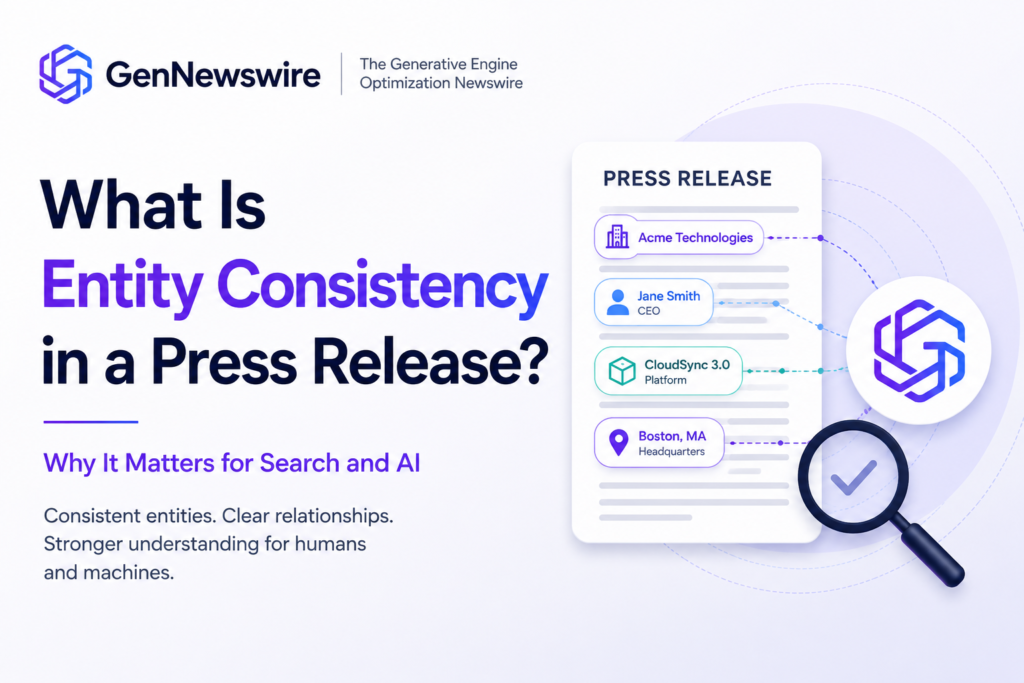
Short answer: Entity consistency in a press release means identifying important companies, people, products, locations and organizations clearly and keeping their names, attributes and relationships factually consistent throughout the release and across authoritative company sources. It is not about repeating keywords or company names. It is about reducing ambiguity so readers, search engines and AI systems can more easily understand who or what a passage refers to, what happened and how the entities within an announcement relate to one another.
Entity consistency is not keyword repetition. It is factual and contextual stability.
Key Takeaways
- Entity consistency is about identity, not keyword density. A company does not need to repeat its full name in every sentence, but important references should remain unambiguous.
- Names are only one part of entity consistency. Executive titles, product relationships, locations, company descriptions and other important attributes should also remain factually consistent.
- Consistency extends beyond a single press release. Important company facts should align with authoritative sources such as the corporate website, newsroom and structured data.
- Newswire distribution can scale errors as easily as accurate information. Entity information should therefore be verified before distribution.
- Entity-Centric PR Writing reduces unnecessary inference. The objective is to give humans and machines enough context to understand who did what, what belongs to whom and where important claims originated.
What Is an Entity in a Press Release?
An entity is an identifiable person, company, organization, product, place, event or other distinct thing being discussed.
A typical press release may contain dozens of entities.
For example:
- Organization: Microsoft Corporation
- Person: Satya Nadella
- Product: Microsoft Copilot
- Location: Redmond, Washington
- Event: Microsoft Build
- Exchange: Nasdaq
- Research: a specifically named report or study
Entities are not simply keywords.
The phrase Microsoft Copilot, for example, does more than provide two words for a search engine to index. It identifies a specific product and establishes potential relationships with other entities in the story: Microsoft developed it, customers use it, executives discuss it and particular features belong to it.
Those relationships give the information meaning.
This distinction becomes especially important in press releases because corporate announcements frequently introduce new relationships between entities.
A company launches a product.
An executive joins an organization.
One company acquires another.
A product becomes available in a particular country.
A study finds a particular result.
A company reports a particular performance figure.
Good press release writing makes those relationships clear.
What Is Entity Consistency in a Press Release?
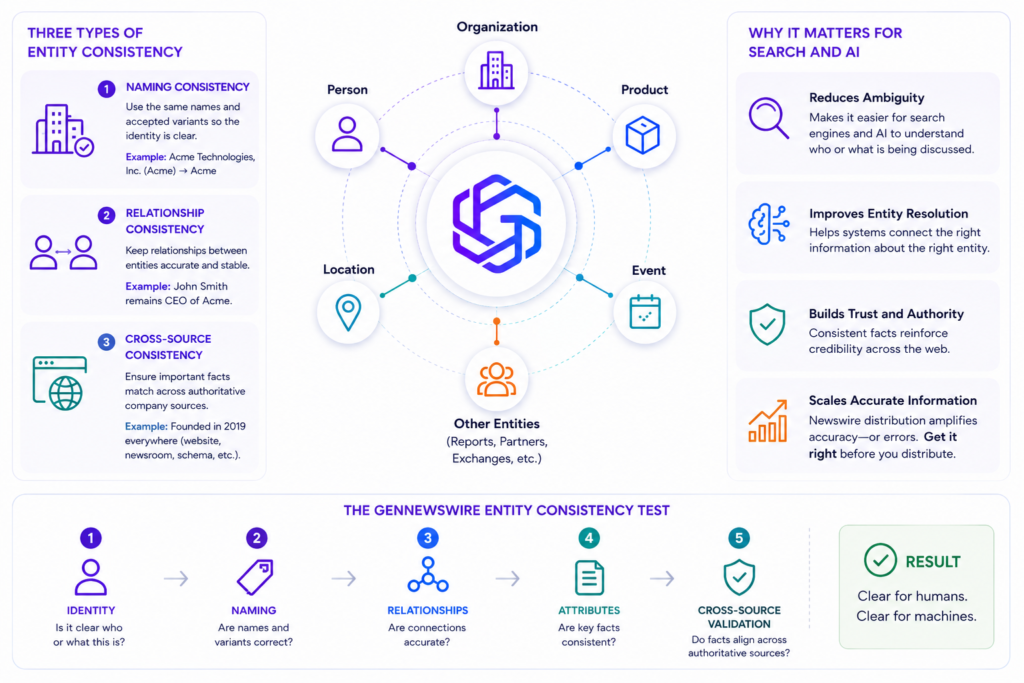
Entity consistency means keeping the identity, naming, attributes and relationships of important entities factually stable throughout a press release and, where applicable, across the organization’s authoritative digital sources.
Consider a company introduced as:
Acme Technologies, Inc. (Acme)
The release can naturally refer to the organization as Acme later. There is little ambiguity because the relationship has already been established.
The problem begins when the same announcement moves unpredictably among:
Acme Technologies
Acme AI
Acme Corporation
ATI
the AI company
without explaining whether these references describe the same organization, separate brands, subsidiaries or different legal entities.
The same problem can occur with people, products and locations.
A product called CloudSync 3.0 should not unexpectedly become Cloud Sync, CloudSync AI, the Cloud platform and Acme AI Suite unless those names and relationships have been properly established.
Entity consistency does not require identical wording.
Consistency does not require identical wording. It requires consistent meaning.
That distinction prevents Entity-Centric PR Writing from turning into mechanical repetition.
Is Entity Consistency the Same as Repeating Keywords?
No.
Entity consistency and keyword repetition solve completely different problems.
A poorly interpreted version of Entity-Centric PR Writing might produce something like:
Acme Corporation today announced Acme Corporation CloudSync 3.0. Acme Corporation said Acme Corporation CloudSync 3.0 will help Acme Corporation customers automate financial reconciliation.
The entities are certainly explicit.
The writing is also terrible.
A natural version might say:
Acme Corporation today announced CloudSync 3.0, a financial reconciliation platform for enterprise accounting teams. Acme said the new platform automates several stages of the reconciliation process.
The first sentence establishes the relationship between Acme Corporation, CloudSync 3.0, its function and its intended users.
The second sentence can therefore use Acme and the new platform without creating meaningful ambiguity.
The objective is not to eliminate pronouns, abbreviations or natural language.
It is to:
Minimize the amount of inference required to understand the information without damaging the quality of the writing.
That is fundamentally different from keyword stuffing.
What Are the Three Types of Entity Consistency?
Entity consistency can be considered at three levels: naming consistency, relationship consistency and cross-source consistency.
1. Naming Consistency
Naming consistency means using entity names and accepted variants in a way that makes their identity clear.
For a company, this might look like:
Acme Technologies, Inc.
↓
Acme Technologies
↓
Acme
The shorter variants are not inherently inconsistent if their relationship to the original entity is clear.
Problems arise when a new name suddenly appears without explanation.
Suppose a release begins with Acme Technologies, Inc. but later refers to Acme AI. A reader may reasonably wonder whether Acme AI is a product, business division, brand, subsidiary or simply another name for the company.
The same principle applies to:
- company names;
- brands;
- subsidiaries;
- product names;
- executive names;
- acronyms;
- research organizations;
- events.
The question is not:
Did we use exactly the same words every time?
It is:
Can the reader reliably determine which entity these words identify?
2. Relationship Consistency
An entity’s name can remain perfectly consistent while the information surrounding it becomes inconsistent.
Consider:
John Smith, Chief Executive Officer of Acme Corporation, said…
Later, the release states:
Acme founder John Smith explained…
If Smith is not actually the company’s founder, the identity of the person has remained stable but his relationship with the organization has changed.
Press releases contain many such relationships:
Person → works for → Company
Company → owns → Brand
Company → develops → Product
Product → provides → Feature
Company → headquartered in → Location
Research → conducted by → Organization
Statistic → attributed to → Source
Claim → made by → Company
Relationship consistency means those connections remain accurate throughout the announcement.
This matters particularly when several companies, executives or products appear in the same release. A phrase such as “the company” may be perfectly clear when only one company is being discussed but ambiguous when a partnership announcement involves three organizations.
3. Cross-Source Consistency
A press release does not exist in isolation.
Important company information may also appear on:
Corporate website
↕
About page
↕
Newsroom
↕
Press releases
↕
Organization structured data
↕
Official company profiles
Google’s guidance on Organization structured data shows how properties such as an organization’s name, URL, logo, address and other identifiers can provide explicit information about the organization represented by a webpage.
Suppose a new press release describes a business as:
Acme AI, a Boston-based financial technology company founded in 2019.
But the company’s website says it was founded in 2018, its official LinkedIn profile lists New York as its headquarters and its Organization schema identifies the business as Acme Technologies.
The problem is not different wording.
The problem is that the underlying facts appear to conflict.
Cross-source consistency therefore means ensuring that important facts about an entity agree across the authoritative sources controlled or maintained by the organization.
The wording does not need to be identical. The underlying fact should be.
Why Does Entity Consistency Matter for Search and AI?
This is where it is important to distinguish documented technical principles from GenNewswire’s methodology.
There is no documented Google ranking factor called “entity consistency.” Nor has Google, OpenAI or another major AI platform published a rule stating that repeating a company’s name consistently in a press release will make that release more likely to receive an AI citation.
That is not what Entity-Centric PR Writing claims.
What is well established is that modern information systems identify entities and relationships in content. Google’s systems, for example, use structured data to understand information about pages and the entities they describe. Google also maintains Knowledge Graph infrastructure for understanding real-world entities and their relationships.
Structured data provides another useful illustration. Information supplied through structured markup should accurately represent the content users can see on the page rather than presenting a contradictory machine-only version of the information.
These principles matter because search and AI systems frequently need to answer a basic question before information can be useful:
Who or what is this passage talking about?
Then:
What happened to that entity?
How is this entity related to the other entities mentioned?
Who made this claim?
Where did this statistic originate?
GenNewswire’s Entity-Centric PR methodology makes a straightforward inference from these principles:
If the publisher can state an important entity relationship clearly, there is little reason to force a retrieval system—or a human reader—to infer it.
Entity consistency therefore isn’t about trying to manipulate an AI algorithm.
It is about removing unnecessary ambiguity from the underlying information.
What Happens When Entity Information Conflicts?
Consider a hypothetical company called Acme Technologies.
Its different corporate sources contain:
| Source | Company Fact |
|---|---|
| Press release | Founded in 2019 |
| About page | Founded in 2018 |
| LinkedIn company page | Founded in 2020 |
| Press release | Headquarters in Boston |
| Website contact page | Headquarters in New York |
| Structured data | Address in Chicago |
Which information is correct?
A human researcher now has to investigate.
The same underlying information problem exists for a machine trying to reconcile multiple representations of the organization.
This does not mean that every apparent difference represents an error.
Context and time matter.
A company may have been founded in one city and later moved its headquarters. An executive may have been Chief Operating Officer in a 2023 release and Chief Executive Officer in 2026. A product may legitimately have been renamed.
Historical information should remain historically accurate.
The objective is not to rewrite old information so that every page describes the company exactly as it exists today.
The objective is to avoid unexplained factual conflict.
Dates, effective periods and clear context can distinguish legitimate change from inconsistency.
How Can Entity Inconsistency Affect Press Release Syndication?
Press release distribution creates a special version of this problem because one source document may be republished across many external websites.
Newswire distribution amplifies information. It can also amplify inconsistency.
Suppose the original release contains an outdated executive title.
Or the wrong product spelling.
Or an incorrect headquarters location.
Or a mistaken ticker symbol.
Or a performance statistic that has been attributed incorrectly.
Once that release is distributed, the information may appear on numerous publisher and syndication pages.
Correcting the original newsroom copy does not necessarily mean every syndicated version will automatically change.
This makes pre-distribution verification particularly important.
The principle is simple:
Verify entities before distribution, not after it.
Newswire distribution should scale accurate information. Without careful entity verification, it can just as easily scale an error.
Which Company Facts Should Remain Consistent?
Not every sentence across a company’s digital presence needs to match. But important factual attributes should have an identifiable source of truth.
| Entity or Attribute | What to Verify |
|---|---|
| Company name | Official name and accepted brand variants |
| Company description | Core business and current positioning |
| Founding information | Founding year and founders |
| Headquarters | Current headquarters and relevant offices |
| Leadership | Full names and current titles |
| Products/services | Official names and accurate descriptions |
| Parent/subsidiary relationships | Correct corporate relationships |
| Ticker/exchange | Exact ticker and exchange information |
| Website | Official canonical domain |
| Media contacts | Current names and contact information |
| Locations | Accurate geographic relationships |
| Statistics | Value, measurement period and source |
| Official profiles | Correct company-controlled accounts |
For frequently changing information, dates matter.
A statement that a company employed 500 people in 2024 is not inconsistent with a statement that it employs 700 people in 2026.
Without the dates, however, the two numbers can appear contradictory.
Entity consistency therefore includes temporal context where the underlying attribute can change.
How Should You Handle Legal Names, Brand Names and Abbreviations?
Press releases often need to distinguish between a legal entity and the brand by which that organization is commonly known.
The cleanest approach is usually to establish the relationship early.
For example:
Acme Technologies, Inc. (“Acme”) today announced…
After that relationship has been established, the release can naturally use Acme.
Similarly:
International Business Machines Corporation (IBM)
can subsequently become:
IBM
The same principle applies when a parent company owns a better-known consumer brand or when a company operates several divisions.
What matters is not forcing the legal name into every paragraph.
What matters is making the relationship clear before relying on the shorter or more familiar reference.
This becomes especially important when the brand name and legal entity are substantially different.
How Should Executive Names and Titles Be Handled?
People are entities too.
A useful first reference generally establishes three pieces of information:
Full name → Current title → Organization
For example:
Jane Smith, Chief Executive Officer of Acme Corporation
Later references can naturally use Smith where the context remains clear.
Titles deserve particular attention because they establish relationships between people and organizations.
These distinctions are not interchangeable:
Founder
Co-founder
Chief Executive Officer
President
Chair
Executive Chair
Managing Director
A founder may no longer be CEO.
A CEO may not be a founder.
A company may have both a president and a chief executive.
AI-assisted drafting can sometimes smooth these distinctions into language that sounds plausible while changing the underlying fact.
Names and titles should therefore be checked against current authoritative information before distribution.
How Do Structured Data and sameAs Help Clarify Entities?
Structured data gives publishers a machine-readable way to describe information already represented on a webpage.
For an organization, Schema.org properties can help identify information such as its name, URL, logo, address and related profiles.
The sameAs property can point to another page that represents the same entity, helping establish relationships between an organization’s website and other authoritative representations of that organization.
But structured data is not a substitute for accurate content.
If the visible company page says the organization is headquartered in Boston while its structured data says Chicago, adding more markup does not resolve the underlying contradiction.
A useful principle is:
Structured data should reinforce accurate visible information, not compete with it.
The source facts need to be correct first.
Markup can then make those facts more explicitly structured for machines.
What Is the GenNewswire Entity Consistency Test?
Before distributing a press release, GenNewswire recommends evaluating its primary entities across five dimensions.
1. Identity
Can we clearly determine who or what the entity is?
If a reader encounters the company, executive, product or organization for the first time, is enough information provided to identify it?
2. Naming
Are names, abbreviations and accepted variants established correctly?
Check legal names, brand names, product spellings, executive names and acronyms.
3. Relationships
Are the connections between entities accurate?
Who works for which company?
Which company owns the product?
Who conducted the research?
Who made the claim?
Which organization is partnering with which?
4. Attributes
Are important characteristics factually consistent?
Check:
titles, dates, locations, descriptions, statistics, founding information and other relevant attributes.
5. Cross-Source Validation
Do the important facts agree with authoritative company sources?
Compare the release against the website, newsroom, approved corporate information and relevant structured data.
The complete test is:
Identity → Naming → Relationships → Attributes → Cross-Source Validation
If an important entity fails one of these checks, resolve the inconsistency before distribution.
What Does Entity Consistency Look Like in Practice?
Consider this hypothetical passage:
TechNova announced the launch of NovaAI today. The company said its platform will help financial organizations automate reporting. According to TechNova AI founder Sarah Lee, the solution was developed at the company’s New York headquarters. TechNova Technologies, which is based in Boston, expects the product to become nationally available next quarter.
A human reader can probably infer parts of the story.
But several questions immediately appear:
Is TechNova the same organization as TechNova AI and TechNova Technologies?
Is Sarah Lee actually the founder?
Is NovaAI the same thing as the platform, the solution and the product?
Is the company headquartered in New York or Boston?
Did NovaAI launch today, or does it launch next quarter?
Now consider an Entity-Centric version:
TechNova Technologies, Inc. (TechNova) announced NovaAI, its automated financial reporting platform, on August 24, 2026. The company said NovaAI is designed to help financial organizations automate portions of the reporting process.
Sarah Lee, Chief Executive Officer of TechNova, said the platform was developed by the company’s product team in New York. TechNova is headquartered in Boston. NovaAI was announced on August 24 and is scheduled for commercial availability across the United States in October 2026.
The second version does not simply repeat more keywords.
It resolves the relationships.
TechNova Technologies, Inc. → TechNova
TechNova → developer of → NovaAI
Sarah Lee → CEO of → TechNova
New York → product development location
Boston → corporate headquarters
August 24 → announcement date
October → commercial availability
The information becomes easier to understand because the reader has less reconciliation work to perform.
That is the objective of Entity-Centric PR Writing.
What Is the Relationship Between Entity Consistency and Entity-Centric PR Writing?
Entity consistency is one component of the broader Entity-Centric PR Writing methodology.
Entity consistency asks:
Are the facts, names, attributes and relationships surrounding the entity stable and accurate?
Entity-Centric PR Writing asks a broader question:
Is the press release structured so that those entities and relationships remain understandable throughout the document?
A release can technically contain consistent information while still relying too heavily on vague pronouns or distant contextual references.
For example:
The company said it expects the product to become available there later this year.
Nothing in that sentence is necessarily factually inconsistent.
But taken independently, it tells us very little.
Which company?
Which product?
Where is there?
This is where entity consistency connects with the Information Island Test: important passages should contain enough context to remain understandable when encountered outside the document’s immediate narrative sequence.
The goal is not robotic repetition.
It is context preservation.
Entity Consistency Checklist for Press Releases
Before distributing a press release, check:
- Is the official organization name correct?
- Are legal-name and brand-name relationships clearly established?
- Are product and service names spelled consistently?
- Are executive names and titles current?
- Are founder, CEO, president and other roles accurately distinguished?
- Are parent, subsidiary and brand relationships correct?
- Are headquarters and other locations accurately described?
- Are announcement, launch and effective dates distinguished where necessary?
- Are ticker symbols and exchange names correct?
- Are quantitative claims accurately sourced and dated?
- Are ambiguous pronouns making important passages difficult to understand?
- Does structured data agree with visible company information?
- Do important facts align with the corporate website and newsroom?
- Is historical information given enough temporal context?
- Would an important passage remain understandable if encountered independently?
If the answer to the final question is no, apply the Information Island Test and restore the context that matters.
Frequently Asked Questions About Entity Consistency in Press Releases
Does a company name need to be written in full throughout a press release?
No. Entity consistency does not require repeating the complete legal company name in every paragraph. Establish the relationship clearly on first reference, then use natural abbreviations, brand names or pronouns where the intended entity remains obvious.
Is entity consistency an SEO ranking factor?
There is no documented Google ranking factor called entity consistency. Entity consistency is a GenNewswire methodology based on the broader need to communicate entities, attributes and relationships clearly and accurately. It should not be presented as a guaranteed method for improving rankings or AI citations.
Should press release information match the company website?
Important underlying facts should agree with authoritative company information, although the wording does not need to be identical. If the press release and website provide different headquarters, founding dates, executive titles or product descriptions without contextual explanation, the organization should determine which information is correct.
What if an old press release contains outdated company information?
Outdated is not necessarily inconsistent. A 2022 press release accurately identifying someone as CEO in 2022 remains historically correct even if another person holds the position today. Dates and temporal context help distinguish legitimate historical change from contradictory information.
Can structured data fix inconsistent company information?
No. Structured data can make information more explicit for machines, but it cannot make contradictory facts logically consistent. Resolve the source information first, then use structured data to reinforce the accurate visible content.
So, What Is Entity Consistency in a Press Release?
Entity consistency means ensuring that the identity, naming, attributes and relationships of important companies, people, products, locations and other entities remain factually stable and contextually clear throughout a press release and across relevant authoritative sources.
It does not mean repeating a company name in every sentence.
It does not mean stuffing the release with entities.
And it is not a documented shortcut to better Google rankings or AI citations.
The objective is much simpler:
Remove unnecessary ambiguity from the information.
When a company launches a product, say which company launched which product.
When an executive makes a statement, establish who that person is and which organization they represent.
When a statistic appears, make its source and context clear.
When important company facts appear across multiple authoritative pages, make sure those facts agree or that legitimate changes are properly dated and explained.
For humans, that produces clearer corporate communication.
For machines, it provides more explicit information about entities and their relationships.
That is the intersection GenNewswire‘s Entity-Centric PR Writing is designed to reach:
Human-first information, structured clearly enough for machines to understand.