Can I write a press release with AI?
Short answer: AI cannot independently write a good press release. A PR professional using AI can.
Writing a press release with AI should begin with human judgment, original information, verified facts and clearly defined entities—not a clever prompt. AI can help organize source material, develop a first draft, improve structure and refine language, but the news angle, factual claims, attribution, quotes and final editorial decisions should remain under human control.
The goal is not simply to write a press release with AI or to produce an AI-generated press release. It is to create an AI-ready press release: useful to journalists and readers, factually grounded, and structured so search engines and AI systems can understand the people, companies, products, events and claims within it.
AI-generated is not the same as AI-ready.
Key Takeaways
- AI is an assistant, not the source of the news. Human expertise, original information and verified facts should determine what the press release says.
- A sophisticated PR prompt cannot compensate for weak source material. Better inputs produce more useful outputs.
- Entity-Centric PR Writing reduces ambiguity. Companies, executives, products, locations, claims and their relationships should remain clear throughout the release.
- Human value and machine comprehension are not competing objectives. Clear facts, meaningful context and explicit attribution are useful to journalists, readers, search engines and AI retrieval systems.
- The best AI-assisted press release should still be a good press release if AI search did not exist.
This guide goes beyond lists of ChatGPT prompts. It explains how PR professionals can combine human expertise with AI-assisted drafting, Entity-Centric PR Writing and structured verification to produce press releases that work for people while remaining understandable to machines.
Can I write a press release with AI?
No—not independently. A PR expert using AI can.
Modern AI tools can produce text that looks remarkably similar to a professionally written press release. They understand common press release formats. They can generate headlines, summarize source material, organize paragraphs, suggest quotes and imitate journalistic language.
That is not the same as exercising PR judgment.
An AI model does not independently know whether an announcement is genuinely newsworthy. It cannot know whether an internal company statistic is accurate unless reliable source information is provided. It cannot determine whether a CEO genuinely holds an opinion simply because that opinion would make a good quote.
Nor should an AI model be expected to decide, without expert direction, which part of a complicated announcement deserves emphasis, which claim requires qualification, what context a journalist needs or where promotional language creates credibility problems.
Those are editorial decisions.
A PR professional brings something fundamentally different to the process: knowledge of the organization, understanding of the audience, news judgment, context, source verification, communications strategy and accountability for the finished release.
AI can accelerate that expertise.
It should not replace it.
The more useful model is therefore:
Human PR Expertise + Verified Information → AI Assistance → Human Verification and Editorial Judgment → Final Press Release
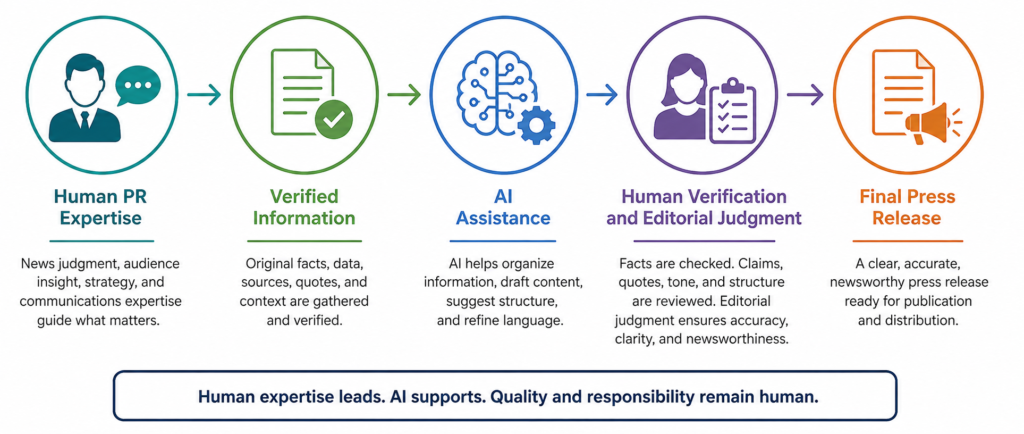
The PR professional directs the process. AI helps execute parts of it.
Why Does AI Produce So Many Generic Press Releases?
Because AI can only work with the information and instructions it receives.
Consider a prompt such as:
Write a professional press release announcing our groundbreaking new AI platform. Make it engaging, exciting and newsworthy.
The model has almost no meaningful information to work with.
It does not know what the platform does, who built it, when it launches, who will use it, what problem it solves, whether its performance has been measured or why the announcement matters.
Yet the instruction still asks it to produce a press release.
The predictable result is often polished language built around generic expressions:
revolutionary technology
game-changing innovation
next-generation solution
transforming the industry
exciting new chapter
The copy may be grammatically correct. It may even sound like a press release.
But it contains very little news.
This creates a simple problem:
Jargon in → jargon out.
Adding another 500 words of prompt engineering does not necessarily solve it.
AI cannot turn weak source information into authoritative corporate information merely by making the language sound professional.
The better solution is to improve the information before asking AI to write anything.
What Information Should You Give AI Before Writing a Press Release?
Before creating the prompt, create the source material.
At GenNewswire, we think of this as an AI Press Release Source Brief.
The purpose is to separate facts from prose.
Instead of immediately asking an AI model to write an announcement, first establish what the model is actually allowed to know and say.
A useful source brief might include:
| Input | Information to Provide |
|---|---|
| Organization | Full company or organization name |
| Organization Context | What the organization does and relevant background |
| Announcement | Exactly what has happened |
| News Significance | Why the announcement matters |
| Date | Announcement, launch or effective date |
| Location | Relevant geographic context |
| Product/Service | Exact product or service names and descriptions |
| People | Full names, titles and organizational relationships |
| Verified Facts | Approved factual information |
| Metrics | Numbers, benchmarks and their sources |
| Claims | Statements the organization can substantiate |
| Evidence | Studies, reports, testing, documents or other support |
| Quotes/Positions | Approved executive comments or source material |
| Restrictions | Claims, language or assumptions the AI must not make |
| Audience | Journalists, customers, investors, industry professionals or others |
This changes the AI’s role.
Instead of asking it to invent a story from a sentence, you are asking it to organize verified information into a press release.
That is a fundamentally different task.
What Is the Best Workflow To Write a Press Release With AI?
A reliable AI-assisted PR workflow should put information and judgment before generation.
1. Establish the News
Before opening ChatGPT, Gemini, Claude or another AI tool, answer the most basic question:
What actually happened?
A product exists.
A company raised capital.
An executive was appointed.
Research produced a finding.
Two organizations entered a partnership.
A business expanded into a new market.
AI should not have to manufacture the news angle because the human operator has not identified one.
2. Identify the Important Entities
List the people, companies, products, locations, events and organizations involved.
For example:
Organization: Acme Corporation
Product: CloudSync 3.0
Executive: John Doe, Chief Executive Officer of Acme Corporation
Market: Enterprise accounting
Location: Chicago, Illinois
This establishes the entity relationships before drafting begins.
3. Assemble the Verified Facts
Separate what is known from what is assumed.
If Acme Corporation measured a 45% reduction in reconciliation processing time, record:
- the 45% figure;
- what was measured;
- how it was measured;
- who conducted the measurement;
- when it was conducted.
A number without attribution can easily become a misleading claim once AI turns it into polished prose.
4. Build the AI Press Release Source Brief
Combine the entities, facts, context, evidence and restrictions into one structured source document.
This becomes the factual boundary within which the AI operates.
5. Ask AI What Is Missing
This is an overlooked use of AI.
Do not ask it to draft the press release yet.
Instead, ask:
Based only on the source information provided, identify any missing information, unclear entity relationships, unsupported claims or factual gaps that should be resolved before writing the press release. Do not infer or invent the missing information.
Now AI is helping the PR professional interrogate the source material rather than immediately generating copy.
6. Generate the First Draft
Only after the information gaps have been addressed should AI begin drafting.
At this point, its job is primarily organizational:
- establish a clear headline;
- summarize the announcement;
- organize supporting facts;
- place quotes appropriately;
- improve transitions;
- maintain a professional editorial structure.
7. Verify Every Claim
Treat AI-generated factual statements as requiring verification against the source brief.
Check names.
Check dates.
Check numbers.
Check product descriptions.
Check titles.
Check geographic information.
Check claims.
Check quote attribution.
AI can produce a statement that sounds completely credible and is completely wrong.
Professional language is not evidence of factual accuracy.
8. Apply PR Judgment
Now return to the larger questions.
Is this genuinely the strongest angle?
Is the lead burying the news?
Would a journalist understand why this matters?
Is the quote contributing information?
Is there unnecessary corporate language?
Does the release provide enough context without becoming an advertisement?
This is where professional judgment matters most.
9. Apply Entity-Centric Editing
Review important passages for vague references and missing relationships.
Replace unnecessary ambiguity with explicit context.
10. Apply the Information Island Test
Take important sections out of the release and read them independently.
Do they still make sense?
If not, restore the context needed for them to stand alone.
11. Complete Human Editorial Approval
The final decision belongs to a person.
AI can suggest.
AI can reorganize.
AI can identify inconsistencies.
The organization and its communications professionals remain responsible for what is published.
12. Prepare the Release for Publication and Distribution
A well-written press release still needs an accessible publishing environment.
That means moving from content creation into newsroom architecture, technical publication, distribution, discovery and potentially AI retrieval.
Writing is only the left-hand side of the equation.
What Is the Best AI Prompt for Writing a Press Release?
There is no single magical prompt that turns incomplete information into good PR.
A better prompt establishes boundaries, source material and editorial responsibilities.
Here is a reusable starting framework.
GenNewswire Entity-Centric Press Release Prompt
You are assisting a PR professional with drafting a press release.
Use only the factual source material provided below. Do not invent, infer or embellish facts, statistics, dates, product capabilities, market positions, customer outcomes or executive opinions.
Before drafting, review the source material and identify:
- missing information required for an accurate press release;
- ambiguous company, product, person or organization references;
- claims that lack supporting evidence or attribution;
- statements that could be interpreted more strongly than the supplied evidence allows.
Ask for clarification where necessary. If information is unavailable, flag the gap rather than filling it with an assumption.
Once the source information is sufficient, draft the press release using these principles:
- identify important companies, people, products and locations explicitly;
- lead with the actual announcement rather than promotional language;
- prioritize verified facts over adjectives;
- attribute statistics, research findings and performance claims;
- do not invent executive quotes;
- use only approved quote material or clearly label suggested wording for human approval;
- avoid unsupported terms such as “leading,” “revolutionary,” “best,” “first” or “industry-changing”;
- preserve enough entity context that important sections can be understood independently;
- write naturally for journalists and human readers;
- do not insert keywords unnaturally or attempt to manipulate search or AI systems.
After drafting, provide a separate verification list containing every factual claim, number, date, named entity and attributed statement that should be checked before publication.
SOURCE MATERIAL:
[Insert AI Press Release Source Brief]
The value of the prompt is not its length.
The value is that it establishes a simple rule:
When information is missing, ask. Don’t invent.
How Do You Stop AI From Hallucinating in a Press Release?
You cannot make hallucination risk disappear simply by telling an AI model to “be accurate.”
A stronger approach is to control the source material and verify the output.
For the initial drafting stage, use a closed-source approach:
Provided fact → use it
Missing fact → request it
Uncertain claim → flag it
Unsupported claim → exclude it
If an AI model knows that a product launched but has not been given a launch date, it should not select a plausible date.
If a company says a product improves performance but provides no benchmark, the AI should not turn that into “increases efficiency by 40%.”
If an executive’s opinion has not been provided, the model should not invent a quotation because press releases traditionally contain quotes.
The most dangerous AI errors are not always obvious nonsense.
They are often plausible details.
That makes human verification indispensable.
Should AI Write Quotes for Executives?
AI can help write an executive quote. It should not independently decide what an executive believes and publish that statement as authentic.
There is an important difference.
Consider:
“We are thrilled to introduce this groundbreaking solution that represents an exciting new chapter for our company,” said John Doe.
AI can produce variations of that sentence indefinitely.
But what did John Doe actually want to communicate?
Perhaps the important point is that customers were spending 30 hours each month manually reconciling records.
Perhaps the company built the product after repeated customer requests.
Perhaps the strategic significance is entry into a new market.
That substance should come from the executive, company or PR team.
A responsible workflow is:
Executive/source position → AI-assisted formulation → PR editing → Executive approval
AI can help turn rough thoughts, interview notes or approved talking points into concise language.
It should not manufacture the underlying opinion.
What Is the Difference Between an AI-Generated and AI-Ready Press Release?
These terms describe two very different things.
An AI-generated press release
An AI-generated press release is simply a release in which some or all of the text was produced by an AI system.
That tells us nothing about its quality.
It could be accurate or inaccurate.
Useful or generic.
Well researched or entirely derivative.
Clear or ambiguous.
An AI-ready press release
An AI-ready press release is designed to communicate information clearly across both human and machine environments.
Its important characteristics include:
- verified information;
- explicit entities;
- clear entity relationships;
- factual density;
- proper attribution;
- context-complete passages;
- natural language;
- useful structure;
- machine-accessible publication.
An AI-ready press release does not necessarily need to be written by AI.
A skilled PR professional could write the entire release manually and produce an exceptionally AI-ready document.
Conversely, a press release generated entirely by the latest AI model could be poorly suited to AI retrieval if it contains vague entities, generic language, unsupported claims and little original information.
This is why:
AI-generated is not the same as AI-ready.
What Does “Gold Material for AI” Actually Look Like?
The most useful material for AI is not necessarily material produced by AI.
It is information worth retrieving.
Imagine hundreds of articles repeating:
Artificial intelligence is transforming business by helping organizations improve efficiency and drive innovation.
The sentence is readable.
But it contributes little new information.
Now consider:
Acme Corporation launched CloudSync 3.0 on October 14, 2026, following an 18-month development program. According to an internal benchmark conducted by Acme Corporation in September 2026, the platform reduced average financial reconciliation processing time by 45% during testing.
This passage introduces information about identifiable entities.
It tells us:
- who acted;
- what was launched;
- when;
- what the product does;
- how long development took;
- what performance was reported;
- and who supplied the performance evidence.
That is substantially more useful information.
A good press release can introduce new facts about a company, person, product, event or organization into the public information ecosystem.
That is one reason human expertise remains so important.
The valuable input isn’t merely prose.
It is:
Original knowledge + Verified facts + Human judgment + Evidence + Context + Attribution
AI can help organize and communicate that material.
It cannot legitimately manufacture the underlying corporate reality.
A useful way to express the difference is:
Jargon in → jargon out.
But:
Knowledge in → useful information out.
The objective should therefore be human-first, machine-readable information.
What Is Entity-Centric PR Writing?
Entity-Centric PR Writing structures a press release so that important people, organizations, products, locations and events remain clearly identifiable throughout the announcement.
Consider:
The company said its new platform would help customers reduce processing times. It will initially be available in the United States.
The paragraph depends heavily on surrounding context.
Which company?
Which platform?
Which customers?
Now compare:
Acme Corporation said CloudSync 3.0 will help enterprise accounting teams reduce financial reconciliation processing time. CloudSync 3.0 will initially be available to customers in the United States.
The second version establishes explicit relationships between the company, product, audience, function and market.
That does not mean repeating the company name unnaturally in every sentence.
Entity-Centric PR Writing is not keyword stuffing.
It is context preservation.
The objective is to remove ambiguity where ambiguity could weaken understanding.
What Is the Information Island Test?
The Information Island Test is a simple way to evaluate whether an important press release passage contains enough context to stand independently.
Take a paragraph or subsection.
Remove everything before it.
Remove everything after it.
Then ask:
If someone encountered only this passage, would they still understand who is involved, what happened, what is being claimed and where the information came from?
If yes, the passage functions as an information island.
If no, it may rely too heavily on context elsewhere in the release.
This matters to human readers who skim documents.
It may also matter in retrieval environments where a search or AI system surfaces a particular passage rather than requiring the entire document to be consumed sequentially.
The solution is not to repeat everything everywhere.
It is to ensure that important facts carry enough context with them.
Should You Write Press Releases for Humans or AI?
Humans first. Machines clearly.
Writing primarily for an imagined AI algorithm can produce exactly the kind of content companies should avoid: repetitive entities, artificial sentence structures, excessive formatting and language written for a machine rather than a reader.
That misses the point.
Journalists want facts.
Readers want clarity.
Search systems need understandable content.
AI retrieval systems benefit from identifiable entities, context and attribution.
There is substantial overlap.
Human value comes from:
- original information;
- newsworthiness;
- expert judgment;
- context;
- evidence;
- accountability.
Machine comprehension benefits from:
- explicit entities;
- clear relationships;
- factual statements;
- attribution;
- logical structure;
- context-complete passages.
The sweet spot is not “AI content.”
It is clear, useful information that works for people and can be interpreted by machines without unnecessary guesswork.
Or more simply:
Don’t write press releases for AI. Write better press releases in a way AI can understand.
Can You Use ChatGPT, Gemini, Claude or Other AI Tools to Write Press Releases?
Yes.
The methodology is not dependent on a particular AI model.
ChatGPT, Gemini, Claude and other capable large language models can all assist with parts of the press release workflow.
The important distinction is not simply which model you use.
It is how you use it.
A sophisticated model given poor source material can still produce a poor press release.
A capable model working from a carefully constructed factual brief under the direction of an experienced PR professional can be much more useful.
Model capabilities will continue changing.
The fundamental workflow is more durable:
Human expertise → Structured source information → AI assistance → Human verification
Rather than asking which AI can replace the PR professional, companies may get better results by asking:
Which parts of the PR professional’s workflow can AI improve without surrendering judgment, accuracy or accountability?
How Do You Prepare an AI-Assisted Press Release for Distribution?
Finishing the copy is not the end of the process.
This is where AI-assisted writing connects with AI-centric press release distribution.
The complete information lifecycle looks more like:
Human Expertise
↓
Original Information
↓
Entity Definition
↓
AI-Assisted Drafting
↓
Human Verification
↓
Entity-Centric PR Writing
↓
AI-Ready Publication
↓
Newswire Distribution
↓
Discovery
↓
Indexing
↓
Retrieval
↓
Potential Citation
The first half determines the quality of the information.
The second determines how that information enters the wider web ecosystem.
This distinction matters because an excellent press release published in an inaccessible environment can still struggle with discovery.
Likewise, distributing a weak press release across hundreds of websites does not improve the quality of the underlying information.
As explored in GenNewswire’s guide to which newswire AI engines prefer, distribution, newsroom architecture, crawlability, structured data, entity clarity and passage-level usefulness all play different roles in AI discovery.
Creation and distribution therefore should not be treated as separate strategies.
They are two sides of the same information lifecycle.
AI Press Release Quality Checklist
Before publishing an AI-assisted press release, ask:
- Is there a genuine announcement?
- Did a human determine the news angle?
- Was the AI given verified source information before drafting?
- Are the main company, people, product and organization entities clearly identified?
- Have all names, titles, dates and numbers been checked?
- Are quantitative claims supported and attributed?
- Has the AI introduced any information that was not present in the approved source material?
- Do executive quotes represent genuine, approved viewpoints?
- Have generic AI phrases and unnecessary promotional adjectives been removed?
- Are company claims clearly distinguished from independently established facts?
- Does every important section pass the Information Island Test?
- Is the release useful and natural for journalists and human readers?
- Would this still be considered a good press release if AI search did not exist?
- Will the final release be published on an accessible, persistent and machine-readable page?
If the answer to the second-last question is no, the release has probably been optimized for the wrong audience.
Frequently Asked Questions About Writing Press Releases With AI
Can ChatGPT write a press release?
ChatGPT can assist with drafting a press release, but it should work from verified source information and under human editorial control. A PR professional should determine the news angle, validate factual claims, control attribution and approve the final release. Asking ChatGPT to create a press release from a vague one-line prompt increases the likelihood of generic language, unsupported assumptions and missing context.
What is the best AI for writing press releases?
There is no universally best AI model for every press release workflow. ChatGPT, Gemini, Claude and other capable models can help organize information, draft copy and edit language. The quality of the source material, instructions and human PR judgment can matter more than simply choosing one model over another.
What is the best AI prompt for a press release?
The best prompt is one built around verified source information rather than instructions to make the release “exciting” or “newsworthy.” It should define the entities, announcement, evidence, claims, restrictions and attribution rules and instruct the AI to flag missing information rather than invent it.
Is it okay to use AI to write a press release?
AI can be used responsibly as part of the press release writing process. The organization publishing the release remains responsible for its accuracy, claims, quotations and representations. Human review is therefore essential before publication.
Should you disclose that AI helped write a press release?
The answer can depend on the organization’s policies, contractual obligations, industry requirements and the extent of AI involvement. AI assistance does not remove the publisher’s responsibility for the final content. Organizations should establish clear internal policies governing AI use, verification, confidentiality and approval rather than assuming one disclosure rule applies universally.
Where GenNewswire Fits
GenNewswire is being built around the principle that AI should enhance PR expertise rather than replace it.
That philosophy applies to both sides of the press release lifecycle.
On the creation side, it means combining human knowledge, verified source material and PR judgment with AI-assisted organization and drafting.
On the publishing side, it means thinking about entity clarity, newsroom architecture, machine accessibility, structured information, distribution and retrieval from the beginning.
The broader model is:
Human Expertise → AI-Assisted Creation → Entity-Centric PR → AI-Ready Publication → Distribution → Discovery
GenNewswire does not approach AI-centric PR as an exercise in generating more content faster.
The objective is to create and distribute better information—information that remains useful to journalists and readers while carrying enough factual, entity and attribution context for machine systems to understand it.
So, How Should You Write a Press Release With AI?
Use AI as an assistant, not as the source of the press release.
Begin with human PR judgment. Establish what is actually newsworthy. Assemble original source information. Verify the facts. Define the people, companies, products and other entities involved.
Only then bring AI into the process.
Use it to interrogate the source material, identify gaps, organize information, develop a draft and improve clarity. Then return the release to human control for fact-checking, editorial judgment, attribution, Entity-Centric editing and final approval.
The best AI-assisted press release should not read as though it was engineered for an algorithm.
It should be genuinely useful to a journalist.
Clear to a customer.
Defensible by the company publishing it.
And sufficiently structured that a machine can understand the information without having to guess what the writer meant.
The objective isn’t AI-written PR. It is human expertise, amplified by AI, producing information worth discovering.