Press release visibility is no longer determined by search alone.
For much of the digital newswire era, visibility followed a familiar path: a press release was published, distributed across media outlets, indexed by search engines and discovered by people searching for the company, announcement or related topic.
That pathway still matters. But AI-generated answers have introduced another layer of information discovery.
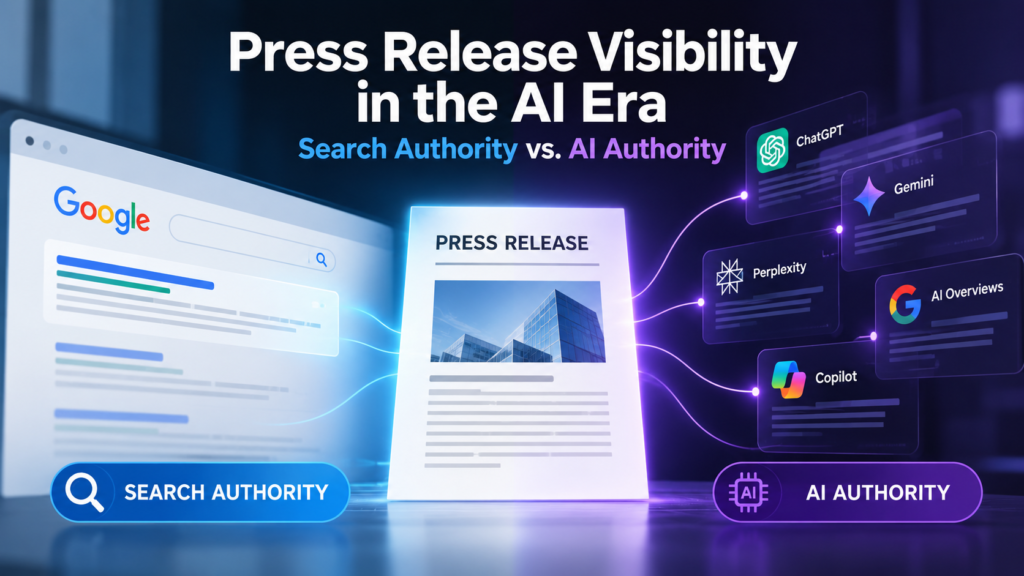
A press release can now become part of the source material used by ChatGPT, Gemini, Perplexity, Microsoft Copilot, Google AI Overviews and other AI-driven information systems. In this environment, being published and indexed does not necessarily mean the information will be retrieved, understood or cited.
This creates two overlapping dimensions of press release visibility: Search Authority and AI Authority.
Search Authority helps information become indexed, ranked and discovered through traditional search. AI Authority describes a source’s demonstrated ability to become useful within AI-generated answers through retrieval, understanding, attribution and citation.
The two share important foundations, but they are not identical.
Where a press release is published still matters. Whether its information can be retrieved, understood and used by AI now matters too.
Key Takeaways
- Search Authority and AI Authority overlap, but they are not the same. Strong traditional search visibility does not guarantee equivalent visibility across AI-generated answers.
- There is no single universal measure of AI Authority. Citation patterns can vary between AI platforms, subjects, queries and over time.
- Publication authority remains important. AI does not make established media, search visibility or authoritative distribution obsolete.
- The information inside the press release matters alongside the domain publishing it. Clear entities, factual attribution, context and independently understandable passages make information easier to retrieve and use.
- Press release distribution now has two visibility objectives: helping information become discoverable through search and making that information usable within AI-driven information discovery.
What Does Press Release Visibility Mean in the AI Era?
Traditionally, digital press release visibility could be represented by a relatively straightforward information path:
Press Release → Publisher → Search Engine → Search Result → Reader
A company distributes an announcement. News and syndication websites publish it. Search engines crawl and index those pages. Someone searching for the company, announcement or related topic may then encounter the release.
That pathway has not disappeared.
AI introduces another:
Press Release → Publisher → AI Retrieval → AI-Generated Answer → User
The difference is significant.
In conventional search, the search engine generally presents sources for the user to evaluate and visit. In an AI-generated answer, another information-processing layer exists between the source and the user.
An AI system may retrieve information from multiple sources, identify relevant passages, interpret entities and relationships, synthesize information and cite some of the sources supporting its response.
The user may therefore encounter information from a press release without following the traditional search journey.
This does not eliminate search. It expands the environments in which corporate information needs to remain visible.
That is where the distinction between Search Authority and AI Authority becomes useful.
What Is Search Authority?
Search Authority describes the ability of a source or webpage to establish sufficient relevance and credibility to gain visibility through conventional search.
It should not be confused with third-party SEO metrics such as Domain Authority or Domain Rating, nor should it be treated as a single formal Google metric.
In practical terms, search visibility emerges from multiple factors, including crawlability, indexation, relevance, page quality, links, reputation, technical accessibility and the broader signals search systems use to evaluate webpages.
The conventional information pathway can be simplified as:
Crawl → Index → Evaluate → Rank → Discover → Click
For press release distribution, Search Authority has traditionally made established publications particularly valuable.
Publishing an announcement on a recognized news or industry website can provide a company with a discoverable and indexable third-party version of its announcement. Authoritative distribution can expand the number of places from which the information can be discovered.
That remains valuable.
But AI-generated answers introduce another question.
Instead of asking only:
Can this press release be discovered in search?
PR teams increasingly need to consider:
Can the information inside this press release be retrieved and used when an AI system constructs an answer?
That is where AI Authority enters the picture.
What Is AI Authority?
AI Authority describes a source’s demonstrated ability to become a useful source of information within AI-generated answers.
It is not a known score assigned by ChatGPT, Gemini, Perplexity or another AI platform. There is no universal public “AI Authority score.”
The concept is better understood through observable behavior: which sources AI systems retrieve, reference or visibly cite when answering particular kinds of questions.
The information journey can be represented as:
Discovery → Retrieval → Entity Understanding → Passage Selection → Synthesis → Attribution/Citation
A webpage can therefore be accessible to an AI system without necessarily becoming useful evidence for an answer.
Likewise, an authoritative domain does not make every sentence published on that domain equally useful.
An AI system may still need to determine:
- Who is being discussed?
- What happened?
- Which company owns or launched the product?
- Who made the claim?
- What does a statistic actually measure?
- When did the event occur?
- Can the statement be clearly attributed?
- Does the passage provide enough context to answer the question?
This is why GenNewswire distinguishes source authority from information clarity.
Authority can help information enter the consideration set. Clear information gives retrieval systems something usable to work with.
Search Authority vs. AI Authority: What Is the Difference?
The distinction becomes clearer when the two information environments are compared.
| Search Authority | AI Authority |
|---|---|
| Primarily concerned with search discovery | Primarily concerned with retrieval and use within AI answers |
| Visibility commonly expressed through rankings and search presence | Visibility commonly observed through mentions, source usage and citations |
| A webpage competes for search-result visibility | A passage may compete to provide evidence for an answer |
| The user generally evaluates the source after seeing the result | The AI system may synthesize information before the user encounters the source |
| Click-through is an important outcome | Information may appear in an answer without generating a traditional click |
| Links, relevance, reputation and search quality signals matter | Source suitability, entity clarity, factual usefulness, context and attribution can affect how usable information is |
| Performance varies by search query | Citation behavior can vary by query, topic and AI platform |
These are not opposing systems.
AI Authority is developing within an information ecosystem that still depends heavily on the open web, publishers, search infrastructure and accessible information.
A page does not become authoritative to AI simply because it has been optimized for an AI crawler. Likewise, strong Search Authority does not automatically mean an AI system will use that page when answering every relevant question.
Is There One Universal AI Authority?
Probably not—and observable citation research provides good reason to be cautious about thinking that way.
In the research reviewed for this article, only 15 domains reached the Top 100 cited sources across all six measured platform families: Google AI Overviews, Google AI Mode, ChatGPT, Gemini, Perplexity and Microsoft Copilot. Across the six platform-specific Top 100 lists, there were 246 distinct domains. Only 15 appeared in every list, while 117 appeared in only one platform’s Top 100. Pasted text
That does not establish that these AI platforms maintain formal authority scores or permanent preferred-source lists.
It demonstrates something narrower and more useful:
Source prominence observed on one AI platform should not automatically be assumed to transfer to another.
A publication can be frequently cited by one platform and substantially less prominent on another.
This gives PR teams another reason not to reduce AI visibility to a simple list of “AI-friendly publications.”
There may be broad source authority, but there is also observable platform-specific citation behavior.
AI Authority Can Also Be Topic-Dependent
Citation patterns can vary by subject as well as platform.
Within the high-stakes consumer-decision research reviewed for this article, the Top 100 cited domains accounted for 74.8% of domain-response appearances in credit, debt, banking and lending, compared with 44.9% in health and medical decisions. Pasted text
The important lesson for PR is not the percentages themselves.
It is that:
AI Authority requires context.
A publication that is highly visible when AI engines answer financial questions may not possess equivalent visibility for healthcare, cybersecurity, travel or enterprise software questions.
The same principle already exists in good media relations. A respected specialist technology publication can be more relevant to a software announcement than a much larger but unrelated general-interest website.
AI discovery adds another dimension to that contextual authority.
The question therefore evolves from:
How authoritative is this website?
to:
How authoritative is this source for this subject, this entity, this information need and the AI platforms that matter?
Search Authority Can Be Persistent While AI Authority Is Platform-Specific
Another finding from the research makes the distinction clearer.
At the aggregate level, the measured Top 100 source sets were relatively persistent over the three-month observation period. Median monthly Top 100 similarity was 85.2%.
But median similarity between platform-specific Top 100 source sets was only 36.1%. Pasted text
In simple terms:
Many prominent sources remained prominent over time.
But:
Different AI platforms did not necessarily agree on which sources should be most prominent.
For communications teams, that distinction matters.
A publication can possess durable authority within an information category without receiving equivalent visibility across every AI environment.
This is why GenNewswire does not treat AI Authority as a permanent characteristic attached to a domain.
It is better understood in context:
Source + Topic + Query + Platform + Time
Why Does This Change the Meaning of Media Authority?
Newswire distribution has traditionally emphasized the authority of the publication.
A distribution report may highlight:
- publisher reputation;
- domain strength;
- estimated traffic;
- search visibility;
- geographic reach;
- industry relevance.
These remain useful indicators.
But they describe only part of the emerging visibility environment.
PR teams now have another question to consider:
Does this publication also appear as a useful source within the AI information environments relevant to the announcement?
This does not mean replacing established media metrics with AI citation counts.
Citation frequency alone does not establish accuracy, editorial independence, endorsement or business impact. The underlying research itself cautions that source rankings should be treated as source maps rather than media-buy lists. Pasted text
Instead, AI visibility becomes an additional dimension of media authority.
A modern distribution strategy can therefore consider:
Publisher Authority + Search Authority + Topical Relevance + Observed AI Authority + Information Quality
That provides a more complete picture than simply asking how many websites carried the release.
Why Doesn’t High Search Authority Automatically Create AI Authority?
Consider a press release published on an extremely authoritative website.
The domain itself may be highly trusted and frequently indexed.
But imagine that an important passage in the release says:
The company announced its innovative new solution, which management believes will transform the industry. The platform will provide customers with several next-generation capabilities.
For a human reading the entire release from the beginning, the missing context might be recoverable.
Encountered independently, however, the passage leaves fundamental questions unanswered.
Which company?
Which solution?
Which industry?
What does the product actually do?
Which capabilities?
Who within management made the claim?
The authority of the host publication cannot supply facts the passage itself fails to communicate.
Compare that with:
Acme Technologies launched CloudSync 3.0, an automated financial reconciliation platform for enterprise accounting teams. The company said the platform automates transaction matching, exception identification and reconciliation reporting.
Now the information contains identifiable entities, relationships, functions and context.
This illustrates an important distinction:
Domain authority can open the door. Information quality determines what can walk through it.
For AI retrieval, both can matter.
Why Entity-Centric PR Writing Matters to AI Visibility
This is where AI Authority connects directly with Entity-Centric PR Writing.
A press release is fundamentally a network of entities and relationships:
Company → launches → Product
Executive → represents → Company
Company → partners with → Organization
Product → serves → Market
Study → reports → Finding
Claim → attributed to → Source
When these relationships are explicit and factually consistent, the information requires less inference to interpret.
When they are vague, contradictory or dependent on distant context, more inference is required.
This does not mean repeating company names mechanically or filling releases with technical terminology.
It means returning to good PR fundamentals:
Identify the subject.
State the announcement.
Attribute the claim.
Establish the relationships.
Provide evidence.
Maintain factual consistency.
That is why GenNewswire’s approach to AI visibility does not begin with tricks designed to manipulate AI engines.
It begins with the press release itself.
What Does Entity Consistency Have to Do With Press Release Visibility?
Entity consistency means keeping important companies, people, products, locations, attributes and relationships factually and contextually stable.
For example:
Acme Technologies, Inc. → Acme
can remain perfectly clear once the relationship has been established.
But:
Acme Technologies → Acme AI → Acme Corporation
without explanation can create unnecessary ambiguity.
The same applies to executive titles, product relationships, headquarters, founding information, statistics and corporate descriptions.
This becomes even more important across multiple sources.
If a company’s newsroom says it was founded in 2018, its new press release says 2019 and its structured data says 2020, a human or machine trying to establish that fact encounters conflicting information.
Entity consistency therefore supports both sides of the visibility equation.
For search, it contributes to clearer and more coherent information.
For AI, it reduces unnecessary ambiguity around the entities and relationships being retrieved.
Entity consistency is not keyword repetition. It is factual and contextual stability.
Why the Newsroom Matters Alongside Distribution
Press release visibility does not begin and end with third-party syndication.
A company’s own newsroom can serve as an authoritative first-party source for:
- company information;
- leadership;
- products;
- announcements;
- media contacts;
- corporate facts;
- historical releases;
- supporting resources.
This becomes particularly important in an AI information environment.
Distribution creates external reach.
The newsroom creates a persistent first-party source.
An AI-ready newsroom should therefore make press releases accessible in clean HTML, maintain accurate entity information, use appropriate structured data, preserve stable URLs and make important corporate facts easy to locate.
The relationship becomes:
Authoritative First-Party Information
↓
Entity-Centric Press Release
↓
AI-Ready Newsroom
↓
Authoritative Distribution
↓
Search Discovery + AI Retrieval
The newsroom and distribution network perform different jobs.
GenNewswire’s position is that modern press release visibility benefits from both.
Does AI Authority Make Search Authority Less Important?
No.
This distinction is essential.
AI visibility should not become another version of the recurring claim that “SEO is dead.”
Search remains a major information-discovery infrastructure. Publisher visibility remains important. Crawlability, indexing, relevance and authoritative links remain important.
AI systems also operate within a broader information ecosystem built substantially from web-accessible information.
The change is not:
Search Authority → Obsolete
The change is:
Search Authority → No longer the only authority environment worth considering
For PR teams, the objective should therefore not be to optimize a release for AI instead of search.
It should be to publish information capable of functioning effectively in both environments.
The GenNewswire Dual Authority Model for Press Releases
GenNewswire describes the emerging press release visibility environment through a Dual Authority Model.
Search Authority
Can the information be discovered and surfaced through search?
The press release needs to be accessible, indexable, relevant and published within an information environment capable of earning search visibility.
AI Authority
Can the information be retrieved, understood, attributed and used within an AI-generated answer?
Access alone is not enough. The information itself needs sufficient factual and contextual value to become useful evidence.
Together:
SEARCH AUTHORITY
Discovery + Ranking
+
AI AUTHORITY
Retrieval + Understanding + Citation
=
MODERN PRESS RELEASE VISIBILITY
Supporting both are:
Entity Clarity → Factual Accuracy → Attribution → Context → Crawlability → Publisher Authority → Distribution
This is not an algorithm or a claim about a hidden ranking system.
It is a framework for understanding where press release information now needs to perform.
How Can PR Teams Build for Both Search Authority and AI Authority?
The answer is surprisingly traditional.
Start With Verified Information
AI-assisted writing should begin with accurate company facts, not an empty prompt.
Executives, product names, dates, statistics, locations and corporate relationships should be verified before drafting.
Write Around Entities and Relationships
Establish clearly who did what, which product belongs to which organization and who is responsible for important claims.
Increase Factual Density Without Making the Release Robotic
Replace vague promotional statements with concrete facts, dates, specifications, results and attributable information where available.
Make Important Passages Understandable Independently
A reader—or retrieval system—should not always need five preceding paragraphs to understand a key statement.
GenNewswire uses a simple Information Island Test:
If an important passage were encountered independently, would it still communicate the essential fact accurately?
Maintain Entity Consistency
Names, titles, corporate relationships and other important attributes should remain consistent throughout the release and across authoritative company sources.
Maintain an AI-Ready Newsroom
The company’s own publication environment should be crawlable, structured, persistent and factually reliable.
Distribute Through Authoritative, Relevant Publications
Information quality does not eliminate the value of distribution.
Distribution creates discovery opportunities, third-party publication and broader source coverage.
Measure Search and AI Separately
Google rankings and AI citations are not interchangeable metrics.
A communications team interested in both should observe them independently rather than assuming success in one guarantees success in the other.
What Does This Mean for Newswire Distribution?
The traditional newswire proposition has often been expressed through scale:
How many outlets will publish my press release?
Scale still matters.
But AI discovery introduces another dimension.
A forward-looking distribution strategy should increasingly ask:
Which publications are relevant to the announcement?
Which possess meaningful search visibility?
Which appear within relevant AI citation environments?
Is the source press release structured clearly enough to remain useful after publication?
Does the company’s own newsroom provide a reliable first-party version?
This moves newswire strategy from simply counting placements toward understanding the information lifecycle.
For GenNewswire, that lifecycle is:
CREATE → STRUCTURE → PUBLISH → DISTRIBUTE → DISCOVER → RETRIEVE → CITE
Distribution remains a central part of the sequence.
It simply is not the entire sequence.
Frequently Asked Questions
What is AI Authority for a press release?
AI Authority describes the extent to which a source becomes useful within AI-generated answers. For press releases, this means considering whether published information can be retrieved, understood, correctly attributed and potentially cited by AI systems. It is not a formal score assigned by ChatGPT, Gemini or other AI platforms.
What is the difference between Search Authority and AI Authority?
Search Authority relates primarily to a source’s ability to gain visibility through traditional search results. AI Authority relates to whether a source becomes useful within AI-generated answers through retrieval, understanding, attribution and citation. The two overlap, but strong search visibility does not guarantee equivalent visibility across AI platforms.
Does a high-authority website guarantee Press Release Visibility in AI?
No. Publishing on an authoritative website can strengthen discovery and credibility, but it does not guarantee that an AI system will retrieve or cite a particular press release. Relevance, factual usefulness, entity clarity, attribution and context within the release can also affect how usable its information is.
Can a press release rank in Google but not appear in AI-generated answers?
Yes. Search ranking and AI citation are different forms of visibility. A press release may perform well in conventional search while rarely appearing as a cited source in AI-generated answers. A source can also be cited by an AI platform without holding a prominent conventional ranking for an equivalent query.
Do ChatGPT, Gemini, Perplexity and other AI platforms use the same authoritative sources?
Not necessarily. Observable citation research shows substantial differences among the leading sources cited across AI platforms. A source frequently cited by one platform should not automatically be assumed to have the same prominence on another.
How can press release visibility be improved in both search and AI?
Start with accurate, attributable information. Clearly establish companies, people, products and their relationships; maintain entity consistency; provide sufficient context; publish the release in an accessible first-party newsroom; and distribute it through relevant authoritative publications. The objective is not to write separately for search engines and AI systems, but to create high-quality information that both can understand.
The New Question for Press Release Visibility
Digital PR has spent years asking:
Will Google find this?
Newswire distribution asks:
Where will this be published?
AI adds another question:
Will an AI system understand the information well enough to use it?
None of these questions replaces the others.
A press release still needs to be worth reading.
It still benefits from authoritative distribution.
It still needs to be accessible to search engines.
And increasingly, its information should be structured clearly enough to survive retrieval, interpretation and synthesis by AI systems.
That is why Search Authority and AI Authority should not be treated as competing objectives.
Search Authority helps corporate information become discoverable.
AI Authority reflects whether that information can become useful within a new generation of answer engines.
The strongest press release visibility strategy is therefore not to choose one form of visibility over the other.
It is to create authoritative, entity-clear information capable of earning both.
For GenNewswire, this is the larger principle behind AI-centric newswire distribution: do not redesign press releases for AI. Return to the fundamentals of accurate, structured and attributable PR—and publish and distribute that information in ways both people and AI systems can understand.