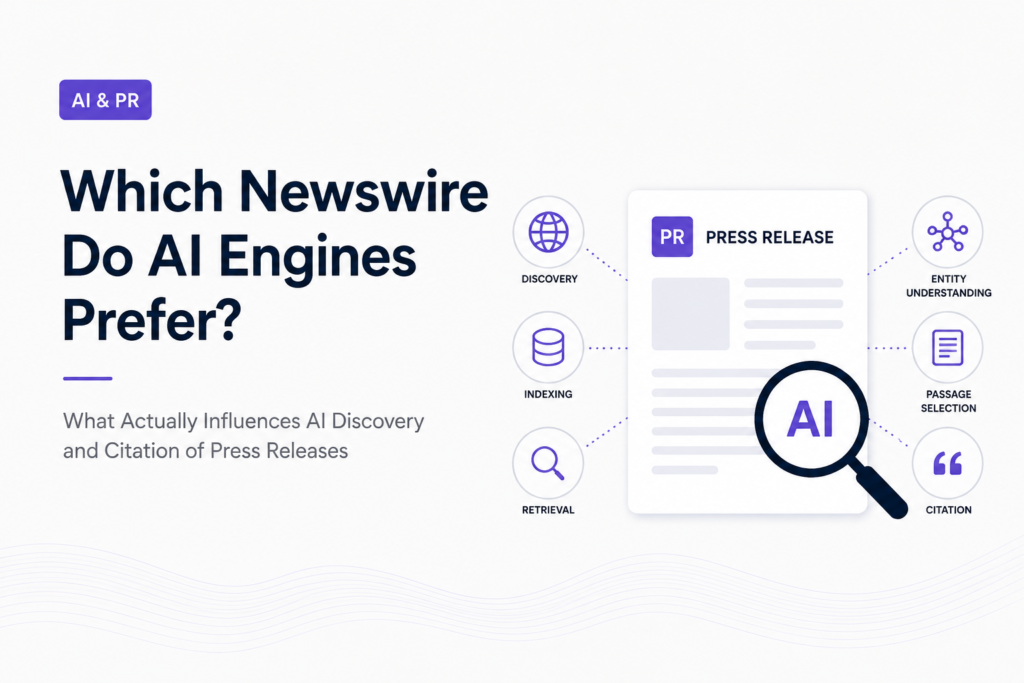
Which Newswire Do AI Engines Prefer?
Short answer: AI engines do not appear to prefer one particular newswire.
There is no publicly documented evidence that ChatGPT, Google AI Overviews, Gemini, Perplexity, Microsoft Copilot, or other major AI discovery systems automatically favor PR Newswire, Business Wire, GlobeNewswire, GenNewswire, or any other press release distribution service.
But that does not mean every press release has the same chance of being discovered, understood, or cited by AI.
The more useful question is:
What makes a press release easier for AI systems to discover, understand, retrieve, and potentially cite?
That is where the newswire industry is beginning to change.
Traditional press release distribution has largely been built around reach: media databases, syndication networks, publisher pickups, geographic coverage, and the number of websites carrying an announcement.
Those factors still matter.
AI-driven discovery, however, introduces another layer.
The writing structure matters.
Entity clarity matters.
The factual usefulness of individual passages matters.
Technical accessibility matters.
And perhaps most importantly, the newswire’s own newsroom matters far more than many companies realize.
For AI discovery, the future of press release distribution may therefore depend less on finding a newswire that AI engines “prefer” and more on choosing a publishing and distribution system designed around how modern search and AI systems access and understand information.
Do ChatGPT, Google or Perplexity Prefer a Particular Newswire?
There is currently no credible public evidence that major AI platforms maintain a universal hierarchy of preferred press release distribution services.
A company might reasonably assume that publishing through a large traditional wire automatically makes its release more likely to appear in an AI-generated answer.
That assumption is too simplistic.
Major newswires can certainly provide important advantages. Their domains may be well established. Their content may be crawled frequently. Their distribution relationships can place announcements across financial portals, news sites and other searchable environments.
But these advantages primarily help solve the discovery problem.
They do not automatically solve the citation problem.
A press release can be successfully published, crawled and indexed without ever becoming the source selected for an AI-generated answer.
That distinction is increasingly important:
Getting discovered and getting cited are not the same thing.
What AI Engines Officially Tell Publishers
Before discussing Generative Engine Optimization, or GEO, it is important to separate documented platform guidance from theories about proprietary AI ranking systems.
Google has been particularly clear on this point.
Its current guidance for generative AI features says the same technical foundations used by Google Search remain important. A page must be indexed and eligible to appear with a Search snippet before it can be eligible for Google’s generative AI search experiences. Google also continues to recommend original, useful content and technically accessible pages.
In other words, there is no separate magic “AI SEO” switch.
Google’s AI systems still depend heavily on the underlying Search ecosystem.
OpenAI provides similarly practical guidance.
OpenAI states that public websites can appear in ChatGPT search and advises publishers not to block OAI-SearchBot if they want their content to be discoverable, surfaced, clearly cited and linked in ChatGPT search results.
Perplexity provides its own crawler guidance. Its documentation says PerplexityBot is used to surface and link websites in Perplexity search results and recommends allowing the crawler in robots.txt if publishers want their sites to appear.
These documented requirements establish an important starting point:
Before a press release can become useful to an AI system, the system has to be able to access it.
Discovery Is Only the First Layer
This gives us a practical way to think about AI visibility for press releases.
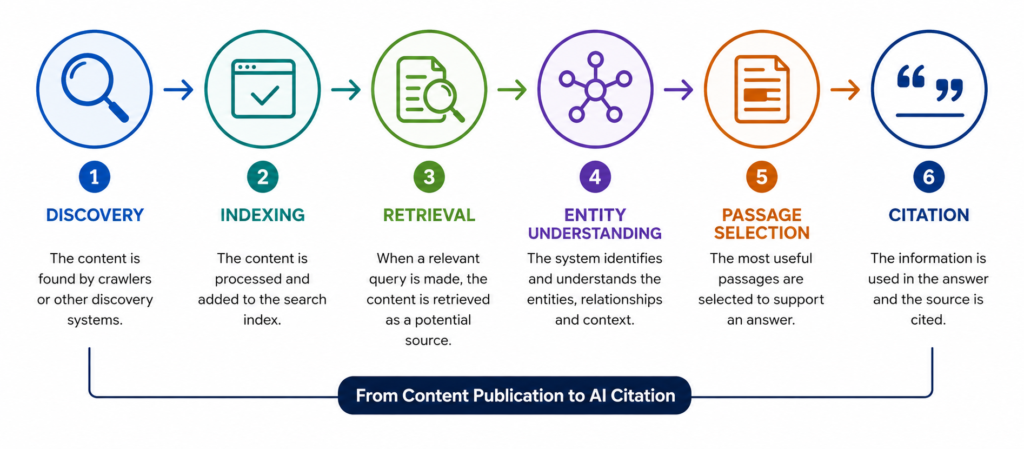
At GenNewswire, we describe the process conceptually as:
Discovery → Indexing → Retrieval → Entity Understanding → Passage Selection → Citation
This should not be interpreted as the exact internal architecture of every AI engine. Google, OpenAI, Perplexity, Microsoft and other platforms operate proprietary systems and do not publicly disclose every ranking or synthesis mechanism.
Instead, the model illustrates the different problems a press release needs to solve.
First, the page has to be accessible.
Then it has to become discoverable or indexed.
When a relevant question is asked, information from the page has to be retrievable.
The system then needs enough context to understand the organizations, people, products, locations and claims involved.
Finally, the information has to be useful enough to support an answer.
Traditional newswire distribution can help substantially with the first few stages.
But press release architecture becomes increasingly important in the later stages.
Distribution Gets Information Into the Ecosystem
Newswire distribution remains valuable.
A distribution service can help an announcement appear across:
- financial portals;
- industry websites;
- regional publications;
- searchable news databases;
- publisher networks;
- media monitoring systems;
- and other third-party environments.
From a traditional PR perspective, this is distribution reach.
From an AI-discovery perspective, it can also be viewed as information availability.
The more places an announcement is available in accessible and credible environments, the more opportunities there may be for search and retrieval systems to encounter the underlying information.
But there is an important limitation.
Imagine a press release syndicated across hundreds of websites that says little beyond:
A leading industry innovator today announced a groundbreaking next-generation solution designed to revolutionize the customer experience.
A large distribution network cannot create factual substance that does not exist in the original release.
If an AI system is trying to answer a specific question, it needs information such as:
- Who made the announcement?
- What exactly was launched?
- When?
- Where?
- Who is it for?
- What does it do?
- What measurable outcome is being claimed?
- Who provided the data?
- What organizations are involved?
This leads to one of the central principles of AI-centric press release distribution:
Distribution increases the availability of information. Structure increases its usefulness.
AI Changes the Unit of PR Writing
Traditional press releases are usually written as complete documents.
The reader begins with the headline, reads the lead, moves through supporting paragraphs, encounters a quote and eventually reaches the boilerplate.
AI retrieval creates a different challenge.
An AI system may not need the entire press release.
The useful information may exist inside a single paragraph, subsection, list, quote or table.
This is broadly consistent with the principles behind Retrieval-Augmented Generation, or RAG, where relevant information is retrieved from external sources and supplied to a generative model when constructing an answer.
Different systems use different retrieval and ranking architectures, and publishers should be cautious about claims that every AI engine chunks content into an exact number of words or tokens.
The practical implication, however, is much easier to understand:
Important sections of a press release should remain understandable when separated from the rest of the document.
The Information Island Test
At GenNewswire, we call this the Information Island Test.
Take an important paragraph or section from the press release.
Remove everything before it.
Remove everything after it.
Now ask:
Does this passage still make complete sense?
Can a reader determine:
- which company is being discussed;
- which product or service is involved;
- what happened;
- what claim is being made;
- who made the claim;
- and why the information matters?
If not, the passage may depend too heavily on context elsewhere in the release.
Consider:
The company said its new platform will significantly reduce processing times. It will initially be available to enterprise customers.
A human who has read the previous five paragraphs may know exactly what “the company,” “its new platform” and “it” refer to.
Now compare:
Acme Corporation said CloudSync 3.0 will reduce financial reconciliation processing time for enterprise accounting teams. CloudSync 3.0 will initially be available to U.S. enterprise customers.
The second version carries its context with it.
That is important for journalists skimming a release.
It may also be useful when machine systems retrieve individual passages rather than interpreting the document exclusively as one continuous article.
Entity-Centric Press Releases
This brings us to one of the foundations of AI-centric PR:
Entity clarity.
An entity is an identifiable person, organization, product, location, event or concept.
Examples include:
- Microsoft Corporation;
- Satya Nadella;
- New York City;
- a named pharmaceutical drug;
- a specific acquisition;
- an identifiable software platform;
- a university;
- a government agency.
Modern search and AI systems continually attempt to determine what entities a document discusses and how those entities relate to each other.
That makes vague PR writing unnecessarily difficult.
Consider:
The company has introduced its latest solution to help organizations improve operations.
There are several unresolved references.
Which company?
Which product?
Which organizations?
Which operations?
Now consider:
Acme Corporation has launched CloudSync 3.0, a financial reconciliation platform designed for enterprise accounting departments.
The second sentence defines the entities and their relationships immediately.
That is what we mean by an entity-centric press release.
Entity-centric writing does not mean awkwardly repeating a company name in every sentence.
It means minimizing unnecessary ambiguity around the most important facts.
AI-Centric Headlines Should Establish Context Immediately
Press release headlines have traditionally been vulnerable to promotional language.
For example:
Industry Leader Unveils Revolutionary Next-Generation Solution
The headline provides very little usable information.
Compare it with:
Acme Corporation Launches CloudSync 3.0 for Enterprise Financial Reconciliation
The second version identifies:
- the company;
- the product;
- the action;
- and the use case.
This makes the headline more useful for search engines, journalists, AI retrieval systems and human readers at the same time.
AI-centric writing should not require sacrificing editorial quality.
In many cases, the characteristics that improve machine comprehension—specificity, clear nouns, explicit attribution and factual language—also make a better press release for humans.
The Lead Should Work as an Answer Capsule
The opening paragraph deserves particular attention.
The traditional Who, What, When, Where and Why model remains useful.
But for AI-centric PR, the lead should also work as a compact standalone description of the announcement.
For example:
Acme Corporation, a Chicago-based enterprise accounting software provider, announced the launch of CloudSync 3.0 on October 14, 2026. The platform automates financial reconciliation workflows for enterprise accounting teams. According to internal benchmark testing conducted by Acme Corporation, CloudSync 3.0 reduced average reconciliation processing time by 45 percent.
That paragraph identifies:
Who: Acme Corporation
What: CloudSync 3.0
Where: Chicago
When: October 14, 2026
Use case: financial reconciliation
Audience: enterprise accounting teams
Claim: 45 percent reduction
Attribution: Acme Corporation’s internal testing
Even outside the rest of the article, the passage retains its meaning.
Factual Density Beats Promotional Density
Press releases frequently contain language such as:
- revolutionary;
- world-class;
- groundbreaking;
- cutting-edge;
- unmatched;
- industry-leading;
- game-changing.
These words may support brand positioning, but they often convey little independently verifiable information.
Compare:
The groundbreaking platform delivers an unmatched and innovative experience that transforms enterprise finance.
with:
CloudSync 3.0 includes automated ledger reconciliation, anomaly detection and audit-trail reporting for enterprise finance teams.
The second sentence provides information an AI system—or a journalist—can actually use.
Useful factual signals in a press release can include:
- dates;
- prices;
- funding amounts;
- geographic markets;
- transaction values;
- product specifications;
- customer numbers;
- research findings;
- performance measurements;
- launch timelines;
- executive appointments;
- named partnerships;
- certifications;
- regulatory milestones.
Not every paragraph needs a statistic.
But every important paragraph should ideally communicate something substantive.
Quotes Need to Carry Information
Corporate quotes are another weak point in many traditional releases.
Consider:
“We are incredibly excited about this groundbreaking milestone,” said John, CEO.
The quote adds little beyond enthusiasm.
Compare:
“CloudSync 3.0 was developed to reduce the manual reconciliation work that frequently delays month-end financial reporting,” said John Doe, Chief Executive Officer of Acme Corporation.
The second quote adds context while clearly identifying the source.
For AI-centric PR, quotes should ideally contribute one or more of the following:
- rationale;
- explanation;
- context;
- evidence;
- strategy;
- consequences;
- future plans.
And attribution should be explicit.
A first name and job title may be understandable to a human reading sequentially.
A full name, title and organization are more context-stable.
Structured Information Can Reduce Ambiguity
Some announcements contain facts that are easier to understand when presented in a structured format.
For example:
Key Launch Details
| Detail | Information |
|---|---|
| Company | Acme Corporation |
| Product | CloudSync 3.0 |
| Launch Date | October 14, 2026 |
| Primary Market | Enterprise accounting |
| Core Function | Automated financial reconciliation |
| Reported Benchmark | 45% reduction in reconciliation processing time |
There is no basis for claiming that adding a table automatically produces an AI citation.
That would overstate what is known.
But clear structural formatting can make information easier for humans and machines to parse because relationships between labels and facts become explicit.
The objective is not to create formatting “for the algorithm.”
The objective is to reduce ambiguity.
Structured Data Provides an Additional Machine-Readable Layer
The visible article is only one part of a modern newsroom page.
Structured data can provide additional machine-readable information about the document.
Google specifically supports Article, NewsArticle and BlogPosting structured data and says this markup can help Google understand information such as the article’s title, author and publication details.
For a press release newsroom, relevant Schema.org entities may include:
NewsArticle;Organization;Person;Product;- and other appropriate types depending on the announcement.
Structured data can help identify information such as:
- headline;
- publication date;
- modification date;
- author;
- publisher;
- organization;
- image;
- description;
- relevant entities.
Google also emphasizes that structured data should accurately represent visible page content.
It should not be used to make claims that do not appear on the page.
And it should not be described as a secret API into an AI model.
Its value is more straightforward:
Structured data provides machines with an explicit representation of what the page contains.
Crawlability Comes Before Citation
AI citation strategies often jump directly to writing techniques.
That skips the most basic requirement.
The page must first be accessible.
Google states that pages intended for its AI search experiences still need to meet normal Search technical requirements.
OpenAI tells publishers to allow OAI-SearchBot if they want content to be available for summaries and snippets in ChatGPT search.
Perplexity similarly recommends allowing PerplexityBot for publishers that want their sites surfaced in Perplexity search results.
For an AI-centric newsroom, that makes technical publishing considerations particularly important.
These can include:
- correct
robots.txtconfiguration; - indexable URLs;
- stable HTTP responses;
- clean HTML;
- reliable page rendering;
- XML sitemaps;
- sensible canonicalization;
- strong internal linking;
- structured data;
- persistent release URLs;
- fast page delivery.
None of these measures guarantees citation.
But poor technical accessibility can prevent otherwise excellent content from participating in the discovery process at all.
IndexNow and Faster Discovery
Timeliness is particularly relevant to press releases.
An announcement may be most newsworthy during the first few hours or days after publication.
IndexNow provides a mechanism through which participating websites can notify supported search engines when a URL has been added, modified or deleted. The protocol allows URLs submitted to a participating endpoint to be shared with other participating search engines.
For a modern newswire, technologies such as IndexNow can therefore be considered part of the broader technical publishing infrastructure.
Again, submitting a URL does not guarantee indexing or AI citation.
It simply helps solve a different problem:
telling participating search systems that new information exists.
Why the Newswire’s Own Newsroom Matters
This may be one of the most underestimated aspects of AI-centric press release distribution.
Traditional newswire discussions tend to emphasize syndication.
A company submits an announcement.
The newswire distributes it.
The release appears on dozens or hundreds of third-party websites.
The list of pickups becomes evidence of reach.
But what happens to the original press release URL?
For AI discovery, that URL should not be treated merely as a staging page for syndication.
It can become an important information asset itself.
A well-designed newswire newsroom can provide:
- a permanent source URL;
- complete release content;
- clear publication dates;
- identifiable company entities;
- identifiable executive entities;
- structured data;
- supporting images and media;
- company background information;
- links to previous announcements;
- company-specific newsroom archives;
- machine-accessible HTML;
- clear publisher attribution.
That creates something traditional syndication metrics do not fully capture:
persistent context.
The Newsroom Can Become an Entity Repository
Consider what happens when a company publishes only one release.
An AI system sees one document discussing the company.
Now imagine the same company distributes 20 announcements over two years.
Those releases may collectively document:
- executive appointments;
- product launches;
- acquisitions;
- partnerships;
- financing rounds;
- geographic expansion;
- research;
- certifications;
- awards;
- company milestones.
If those releases exist as isolated pages with little internal structure, much of that relationship information is left implicit.
A well-designed newsroom can connect them.
A company-specific newsroom page can become a structured archive of public corporate information.
It can associate an organization with:
- its announcements;
- executives;
- products;
- markets;
- historical milestones;
- and related entities.
Over time, the newsroom therefore has the potential to become more than a press release archive.
It becomes part of the company’s entity footprint on the open web.
This may be particularly valuable for emerging companies that have limited Wikipedia presence, sparse mainstream media coverage or an underdeveloped search entity profile.
The Syndication Paradox
Press release distribution also presents an interesting challenge.
The exact same announcement may appear across 50, 100 or several hundred websites.
From a distribution perspective, this demonstrates reach.
From a search perspective, however, these documents are substantially similar.
Search engines have long had mechanisms for dealing with duplicate and syndicated content.
AI retrieval introduces another consideration.
If multiple pages report essentially the same announcement, a retrieval system may have several potential sources for the same fact.
That makes the quality and clarity of the original source increasingly important.
It also means that 300 identical copies are not necessarily equivalent to 300 independent confirmations.
A third-party journalist independently reporting on an announcement is different from 300 websites syndicating the original press release.
Both can create value, but they represent different kinds of signals.
Newswire syndication can create:
Availability and amplification.
Independent reporting can create:
External validation and interpretation.
A sophisticated AI-era PR strategy needs both where possible.
Authority Still Matters
None of this means domain authority or publisher reputation has become irrelevant.
AI systems are required to make decisions about which information sources are suitable to support an answer.
Established news publications, government sites, universities, corporate sources, specialist publications and recognized financial platforms all carry different forms of authority.
Newswire distribution can help place announcements into this broader information environment.
But authority should not be confused with citation certainty.
A useful way to think about the relationship is:
Authority can improve the conditions for discovery and trust.
Information architecture improves the conditions for understanding and reuse.
A strong AI-oriented press release strategy should consider both.
What About llms.txt?
The proposed llms.txt convention has attracted increasing interest among developers, publishers and GEO practitioners.
The idea is to provide AI systems with a simplified map or representation of important website resources.
Some AI companies themselves now publish llms.txt resources for their own documentation. For example, Perplexity’s developer documentation exposes an llms.txt documentation index.
That makes the convention interesting.
It does not, however, establish llms.txt as a universal AI ranking or citation protocol.
Publishers should therefore treat it as an emerging interoperability practice rather than a guaranteed AI visibility mechanism.
For a newswire, the fundamentals remain more important:
- crawlable URLs;
- useful content;
- entity clarity;
- factual attribution;
- strong newsroom architecture;
- structured data;
- internal linking;
- external authority.
llms.txt can complement those foundations.
It should not replace them.
A Five-Point AI Readiness Test for Press Releases
Before distributing a release, companies can evaluate it using five practical questions.
1. Are the entities unambiguous?
Can the company, executives, products, locations and organizations involved be identified without searching surrounding paragraphs for context?
Avoid excessive dependence on phrases such as:
- the company;
- the platform;
- the organization;
- our solution;
- the executive.
Use explicit entity names where ambiguity could otherwise occur.
2. Does the release contain useful facts?
Look for substantive information such as:
- dates;
- numbers;
- features;
- locations;
- pricing;
- markets;
- research findings;
- named organizations;
- measurable outcomes.
Replace unnecessary promotional language with specific information where possible.
3. Can important sections stand independently?
Apply the Information Island Test.
If a section beginning with an H2 and its supporting paragraphs were retrieved on their own, would the reader still understand the subject?
4. Are claims attributable?
Readers—and machines—should be able to determine who is responsible for important claims.
If a statistic comes from company research, say so.
If an executive provides an opinion, identify the executive.
If an external study is referenced, name the source.
5. Is the publication technically accessible?
Check:
- crawler access;
- indexing configuration;
- structured data;
- page rendering;
- sitemap inclusion;
- canonical tags;
- internal links;
- stable URLs.
Writing and technical publishing need to work together.
What Should Companies Look for in an AI-Centric Newswire?
The traditional newswire purchasing decision has often centered on questions such as:
How many websites will carry my press release?
Which major publishers are included?
How many countries does the network reach?
How quickly will the release appear?
Those questions remain relevant.
But organizations that care about AI discovery should begin asking additional questions.
For example:
Does the newswire publish a permanent original newsroom page?
Can AI search crawlers access that page?
Does the page contain structured article data?
Does the wire maintain company-specific newsroom archives?
Are entities clearly represented?
Does the newsroom have a logical internal linking structure?
Does the distribution system support rapid discovery?
Does the wire help structure announcements for factual clarity?
Does the service think about machine retrieval as well as traditional media syndication?
This leads to a broader AI-era newswire model:
Entity → Press Release → Newsroom → Discovery → Distribution → Retrieval → Citation
The press release distribution network remains a critical part of the process.
It is no longer the entire process.
Where GenNewswire Fits?
GenNewswire does not claim that ChatGPT, Google, Gemini, Perplexity, Copilot or any other AI system gives preferential treatment to GenNewswire releases.
There is no credible basis for making such a claim.
Instead, GenNewswire is being developed around a different principle:
Press release distribution should be designed for both human media discovery and machine-driven information retrieval.
GenNewswire approaches AI discoverability at the publishing level rather than treating it as an add-on after distribution.
That includes attention to:
- entity-centric press release writing;
- factual and attribution clarity;
- standalone information sections;
- AI-ready newsroom architecture;
- structured article data;
- machine accessibility;
- persistent release URLs;
- company and entity relationships;
- modern indexing protocols;
- traditional external distribution;
- emerging AI discovery standards.
The objective is not to manipulate generative engines.
It is to make the underlying information easier to access, identify, interpret and attribute.
GenNewswire therefore does not guarantee that an AI platform will cite any individual press release.
No newswire controls the ranking, retrieval or citation systems operated by Google, OpenAI, Perplexity, Microsoft or other third parties.
What GenNewswire can control is the publishing environment.
Its AI-centric approach is designed around current search requirements, machine-readable publishing standards and emerging AI-discovery practices intended to improve the conditions under which press releases can be discovered, understood, retrieved and potentially cited.
So, Which Newswire Do AI Engines Prefer?
Based on publicly available information, there is no single newswire that AI engines universally prefer.
And that may ultimately be the wrong question.
Companies should instead ask:
Which newswire gives my announcement the strongest environment for AI discovery and understanding?
That requires looking beyond distribution counts.
Authority matters.
Syndication matters.
Technical accessibility matters.
But so do:
- entity clarity;
- factual density;
- attribution;
- newsroom architecture;
- machine-readable data;
- information persistence.
The press release is no longer only a document written for journalists.
It is also becoming a structured source of corporate information that may be discovered through search engines, AI assistants, research systems and retrieval tools.
Likewise, the newsroom is no longer simply a place where a newswire stores releases.
Done properly, it can become an authoritative information layer connecting organizations, executives, products, announcements and supporting facts.
The AI era is unlikely to eliminate the traditional newswire.
It may redefine what a modern newswire is expected to do.